
Take control of your AI. Automate the busywork. Understand your data.
You run a small or midsize organization, not an IT department. We help you use AI without putting client data at risk, take repetitive work off your team's plate, and get clear answers from your numbers. One local advisor, start to finish.
Take Control of Your AI · a 10-page governance handbook with a 90-day plan
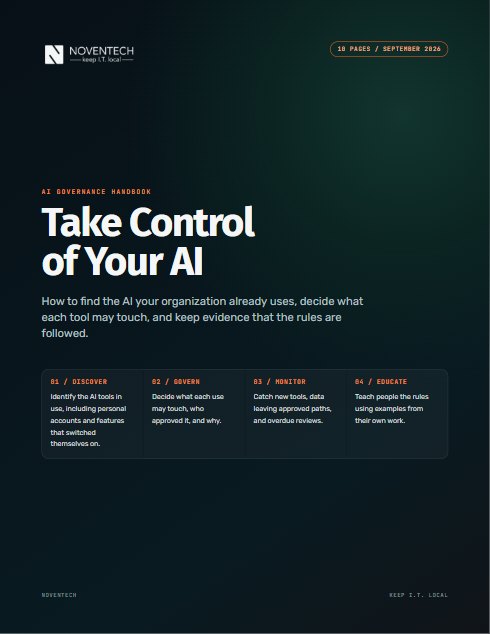 Free handbook 10-page PDF · 12 steps · 90-day plan
- Law Firms
- Marketing Agencies & Teams
- Trades & Field Service
- Accounting & Bookkeeping
- Real Estate
- Healthcare Practices
- Insurance Agencies
- Park Districts
- Special Recreation Districts
- Municipalities & Villages
- Libraries
- Membership Associations
Who we serve
Do you have a plan when it comes to AI?
New AI tools, regulations, best practices, acronyms, and technologies seem to appear every day. It can be difficult to know what matters, what applies to your business, and where to start.
Noventech helps cut through the noise and gives you a clear, practical plan for using AI safely and effectively.
Here's what happens without one.
Your team is already using AI, whether anyone signed off on it or not. Here's one ordinary day in a ten-person office.
A normal Tuesday4:55 PM
- 9:02
The client list goes into a personal ChatGPT account
It now lives in an account your company doesn't own, and you can't pull it back.
- 10:30
A note-taking bot joins the client call
A private conversation is recorded and stored by an outside company.
- 1:15
One click on "Accept" opens up a whole inbox
The app keeps that access long after everyone forgets it's there.
- 3:40
Someone asks Copilot what the team gets paid
It answers, because the payroll folder is shared with the whole company.
- 4:55
The client list is emailed to a personal Gmail
Nothing flags it, and nobody notices.
5risky moments today. Nobody did anything wrong on purpose.
Here's how we help.
We help by keeping the AI your team uses safe and set up right, taking repetitive work off your team's plate, and pulling your numbers into one place you can trust. Each one is its own service, so start with the one that fits where you are today.
Answers you can trust.
We find the AI tools your team is already using, clean up who can see what, and set simple rules everyone can follow. Then we keep watch every month, so Copilot and your agents are limited to what you’ve approved.
- A cleanup of who can see what
- A plain-English AI policy and approved tools list
- Monthly monitoring, data loss prevention, and staff training
- 2New AI tools found
- 5Access grants reviewed
- 1Decision waiting on you
- Customer list in a personal ChatGPT accountClosed
- Old connector still reading a shared mailboxRemoved
- Copilot turned on for the sales teamYour call
Less copy-and-paste.
Most teams have work that follows the same steps every time. An invoice comes in, someone types it into accounting, someone else chases the approval. We build agents in Copilot and the Microsoft 365 tools you already have to handle those steps, and a person still approves anything that matters. Already using ChatGPT, Claude, or another AI tool? We support those too.
- Invoices read and entered for you
- Approvals routed to the right person
- Staff questions answered from your own documents
 Invoice agentCopilot
- OutlookA new invoice arrives by email
- AgentReads the vendor, amount, and due date
- AccountingMatches it to the purchase order
- TeamsOver $5,000, so Dana approves it
- AccountingEnters the bill and logs who approved it
Done in 41 seconds
Your numbers in one place.
Billing, your CRM, scheduling, and that spreadsheet someone updates every Friday. We pull them onto one screen that refreshes on its own, with everything counted the same way, so the answer is there before the meeting, not after.
- Your systems connected, no new logins
- Every number counted the same way
- Updated on its own, maintained by us
Revenue, September$412,380+6.2% vs budget
Past-due invoices3$18,420 outstanding
From billing, CRM, scheduling, accounting, and payroll
Not sure which one fits? See AI use cases for your industry
How we work.
With you the whole way, not just the plan. Whichever service you start with, you work with one person from the first call through setup and support: Vince Davis, our AI Solutions Architect, who has presented on AI governance to public-sector audiences across Illinois.
-
We start with a conversation.
A call with Vince about how your business actually runs and what's bugging you. No sales pitch, and you leave knowing the first step.
-
You get a plan you can read.
We look at your data, tools, and workflows, then write down what to fix first, what it takes, and what it costs. You decide what happens next.
-
We build it and stick around.
We do the work in the systems you already have, train your team, and keep watching after it goes live. The person who planned it is the one who supports it.
- Local
- One point of contact
- All your IT, not just AI
- Vendor-neutral
Before you reach out.
What we hear most before a first call.
Which service do I actually need?
Start with whichever is causing the most pain right now. Worried about how AI is already being used? Start with Governance. A specific task eating your team's time? Start with Automation. Reporting pulled from too many disconnected systems? Start with Data. Not sure? Book a call and we'll help you figure out where to start.
What does this cost?
It depends on scope, and we'd rather talk that through on a call than make you guess from a pricing page. Some engagements start with a free tool, like the AI Policy Builder, before anything is scoped as paid work.
Do we need our own IT person for this?
No. Many small organizations don’t have one, and that’s who this is built for. We handle the technical side, explain every decision in plain language, and leave one person on your team with a short list of things they own, like saying yes or no to a new tool.
Will this replace people on my team?
Not in the work we do. An automation takes the repetitive middle of a process, the copying, the re-entry, the chasing, and leaves the decisions with a person. Every workflow we build has a human approval step where judgment matters, and someone on your team owns it.
We already use ChatGPT. Is that a problem?
Not necessarily. It depends on which version and what goes into it. Business versions of ChatGPT, Copilot, and similar tools can be set up so your company controls the data and it isn’t used for training. Free personal accounts leave those settings up to each person, and you can’t see or manage them. The first step is finding out who uses what, then agreeing on which tools are approved and what information stays out.
How does an engagement actually start?
With a discovery call, not a contract. We talk through how AI and your data are actually used today. For governance, that leads to a one-time implementation, typically 4 to 6 weeks, followed by a monthly managed service. Automation and dashboard work is scoped one project at a time.
Do you replace my current IT provider?
We can, if you want us to. Noventech provides full managed IT and cybersecurity alongside the AI work, so our recommendations fit the computers, accounts, and network you actually have. We can also work alongside your existing provider on just the AI-specific pieces.
What size organizations do you work with?
Small and midsize organizations throughout the Chicagoland area, from a two-partner law firm to a municipality or park district.
Do we need new tools, or can we start with what we already pay for?
Usually what you already own. Microsoft 365, Google Workspace, and most business software now include AI features that are sitting unused, and turning on something you already pay for is cheaper and easier to manage than adding another vendor. We look at what you have first and recommend something new only where there is a real gap.
How do you make sure an automation stays accurate?
Three ways. It runs alongside the manual process at first, and we compare results until they agree. Anything carrying judgment or money keeps a person in the approval step. And every run is logged, with an alert to the owner when one fails or looks unusual, so a broken automation surfaces that day instead of at quarter close.
Why does it matter what data my AI tools can reach?
An AI tool inherits the permissions of whoever connected it. If that person can open every folder on the finance drive, so can the assistant they turned on, and anything it can read can surface in an answer for someone who was never meant to see it. Access is what decides how far a mistake travels, which is why discovery starts with what each tool can reach rather than with the tool's name.
What is the difference between a tool training on our data and retaining it?
Training means your content is used to improve the vendor's model, so it can shape answers given to people outside your organization. Retention means the vendor stores your prompts and files for a period, often for abuse monitoring or support, even when training is switched off. A tool can retain without training, so both belong in the review. The answers frequently differ between the free tier and the paid business tier of the same product.
Not ready to talk? Try a free tool.
Low exposure so far
- LowContained
- Worth a lookSome gaps
- Needs reviewAct soon
Your AI Risk Indicator will move as you answer the questions.
Before you start
Describe one task and answer five questions about its frequency, consistency, judgment, systems, and time cost. You get an initial estimate immediately, and no email is required to see it.
Your estimate
0 / 100
What could be automated?
This is an initial estimate only. Actual automation feasibility depends on the systems involved, available integrations, data requirements, security considerations, and business rules.
Want us to take a closer look?
Tell us a little about the process and Noventech can help determine what can be automated, what should stay human-reviewed, and what technology may be the best fit.